Tactics

How to measure your game model:turning principles of play into metrics

7 min 09.11.2026

Every head coach can describe how their team is meant to play. Ask them to show you, in numbers, whether last Saturday looked like it, and the conversation usually slows down.

That gap between the game model on the whiteboard and the data on the analyst's screen is where a lot of good thinking gets lost. The reason is simple. Most of the metrics clubs work with were built to describe football in general. They tell you whether a performance was good by a common standard. They can't tell you whether it was good by yours.

This article explains what a game model is, why standard metrics struggle to capture one, and how a club can turn its own principles of play into KPIs it can track every week.
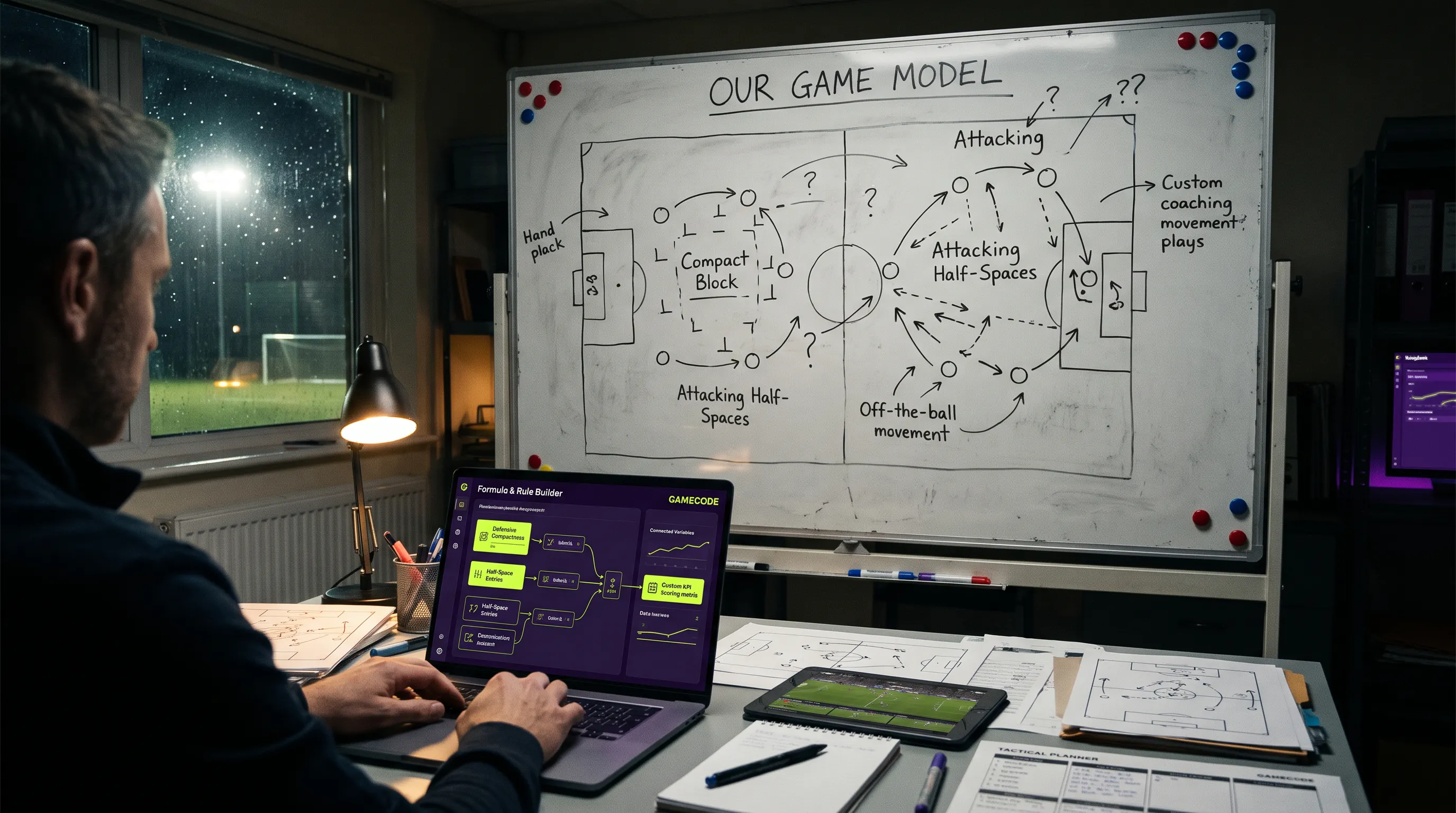
Analyst building game model KPIs on a laptop in front of a whiteboard sketch of the team's game model

What is a game model in football?

A game model is a description of how a team should behave in every phase of the game: in possession, out of possession, and in the transitions between the two. It's the coach's idea of football, written down so that staff and players share the same picture.

Most game models have three layers. Principles describe what the team wants to happen. Sub-principles describe how it makes that happen. Behaviours describe what an individual player does in a specific moment.

Take one example. The principle might be "we progress through the half-spaces". A sub-principle could be "the far-side eight arrives late between the lines". The behaviour is "he checks his shoulder before he receives and opens his body to play forward".

This way of structuring the game is closely linked to tactical periodisation, the coaching method associated with Vítor Frade and Porto, and it's now common across top-level coaching. What's far less common is a way to measure it.

Why can't standard football metrics measure your game model?

Expected goals, possession, PPDA and pass completion are useful numbers. They were designed to compare every team on the same scale, and that's their strength. It's also the reason they struggle with a game model.

The first problem is that a shared metric averages out identity. Two teams can post the same PPDA while pressing in completely different ways. One wants to force play wide and trap the full-back. The other wants to win the ball centrally and attack straight away. The number is identical. The football is not.

The second problem is that most standard metrics are built on events, and events only happen on the ball. GAMECODE.Ai's own estimate is that today's analytics capture less than 1% of what is observable in a match. The rest happens off the ball, roughly 88.5 minutes per player per game.

Look back at the half-space example. Arriving late, checking the shoulder and opening the body all happen before the pass arrives. None of them create an event. That's where most of a game model lives: distances between players, rest defence, the timing of a run, the position of the body. If the data can't see it, the model can't be measured.

How do you turn principles of play into KPIs?

The process is more practical than it sounds. It works best as a conversation between the coach, who holds the idea, and the analyst, who knows the data.

1. Write the principle in the coach's own words. Don't translate it into analytics language yet. "We don't let the ball go long from their keeper" is a better starting point than "high-press success rate".

2. Break it into observable behaviours. What would you see on video if the principle were working? Who is where, at what moment, doing what?

3. Decide what data each behaviour needs. Some behaviours show up in event data. Others need positional tracking. Body orientation and scanning need skeleton or pose data.

4. Define success in your terms. What distance counts as "compact" for your back line? What time window counts as an immediate counter-press? These thresholds are where your identity becomes measurable, so they should come from the coach.

5. Build a metric tree. Put the principle at the top and the sub-metrics underneath. A single headline number is only useful if you can drill down and see why it moved.

6. Check it against video. Sit with the coach and watch the clips the metric flags. If the coach doesn't recognise the moments, the definition needs work.

The last step matters more than people expect. A KPI that the coach doesn't trust won't change a single training session.

What does this look like with a real coach?

One top-flight head coach we work with spent years running his own metric system by hand, on a whiteboard. The ideas were clear. The problem was the time it took to measure them every week.

Those ideas now run as automated KPIs that land on his phone. They include passes that could have been played but weren't, players who should have attacked the space in behind, assists into the club's own scoring zones rather than a generic pitch map, and supportive runs into an opponent's blind spots.

None of these exist at any data provider, because none of them are general. They belong to one coach's idea of football. That's the point.

Who should own your game model?

Once a game model becomes a set of algorithms, it becomes an asset. It describes how the club wants to win, and it gets more valuable every season it runs.

That raises a fair question about where it lives. The industry default has been to buy standardised metrics from a vendor, which means working from the same numbers as your rivals. The alternative, building everything in house, usually means a data science team and a multi-year project.

There is a middle route. The club defines the model and keeps the intellectual property, while a platform handles the engineering. Your data, your models, your edge.

Where GAMECODE.Ai fits

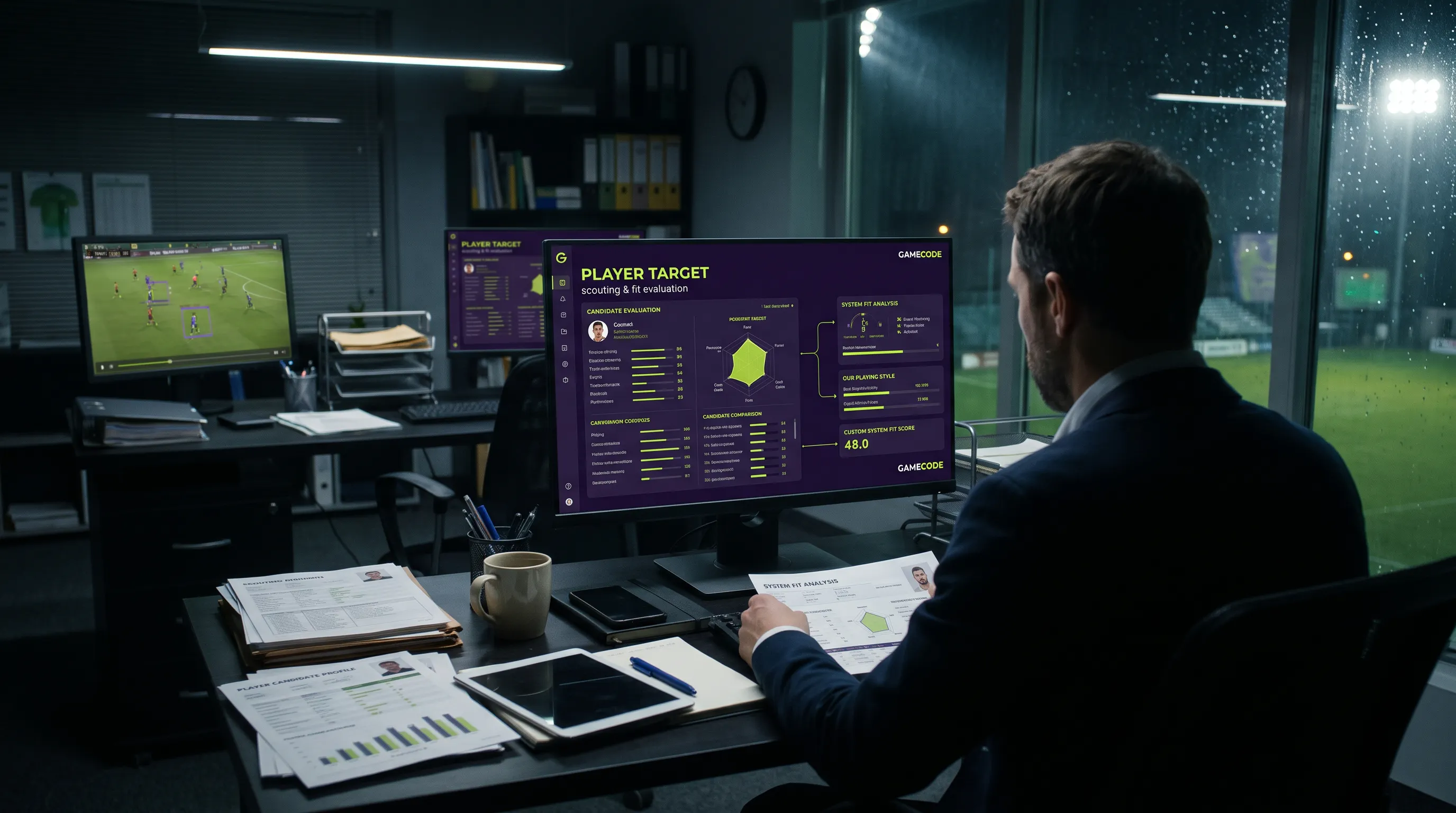
GAMECODE.Ai is built around this process. Gc:Architect is where a coach's principle becomes a metric. Clubs assemble KPIs and metric trees visually, building block by building block, without writing code, and analysts who want to go deeper can code their own. It works with the data providers a club already uses.

For the off-the-ball layer, Architect can run on skeleton and pose data from Gc:Matrix, which turns standard cameras into a tracking system, or from high-fidelity providers such as SecondSpectrum. Gc:Pulse then lets staff ask questions of their own metrics in plain language.

The metrics run automatically after each match and each training session. And the algorithms stay with the club.

Make your game model something you can track

A game model that only exists on a whiteboard relies on memory and opinion to judge it. Turned into KPIs, it becomes something the whole club can measure, discuss and improve week by week, from the first team to the academy.

The question shifts from "how do I win?" to "how do I win my way?" If you'd like to see how a principle of play becomes a metric, get in touch with the GAMECODE.Ai team for a walkthrough.

Core insights

Key takeaways to remember

01

A game model breaks down into principles, sub-principles and individual behaviours, and each layer can be measured.

02

Standard metrics compare every team on one scale, so they average out the identity that a game model describes.

03

Most game model behaviours happen off the ball, so measuring them needs positional and skeleton data as well as events.

04

The thresholds that define success should come from the coach, because that's where a club's identity becomes measurable.

05

Once a game model is codified, it becomes an asset, and the club should own it.

Deep Dive

FAQ

What is a game model in football?

A game model is a coach's or club's description of how the team should behave in possession, out of possession and in transition. It's usually structured as principles, sub-principles and the individual behaviours that make them happen.

How do you measure a playing style in football?

Start with the principle in the coach's words, break it into observable behaviours, and choose the data that can capture each one. Then set your own thresholds for success and check the results against video with the coach.

What is a metric tree in football analytics?

A metric tree puts a headline KPI at the top, such as a principle of play, with the sub-metrics that explain it underneath. It lets staff drill down from one number to the specific behaviours that moved it.

Why don't standard metrics like PPDA capture a game model?

They were designed to compare all teams on the same scale, so two very different pressing styles can produce the same number. Most are also based on on-ball events, while much of a game model happens off the ball.

Who owns the KPIs built from a club's game model?

With GAMECODE.Ai, the club does. The algorithms and metrics built from a club's game model remain the club's intellectual property and are not resold.