
Player Scouting

How to Use Data forYour Transfer Window

6 min 14.07.2026

Open the laptop of almost any recruitment department in Europe this summer, and you'll find broadly the same thing: the same xG models, the same possession-adjusted defensive numbers, the same percentile bars from the same handful of providers. This raises an interesting question. If every club is scouting from the same data, where exactly is your edge supposed to come from?

The transfer window is the most expensive decision-making your club does all year. Yet the underlying analytics are largely standardised. They are built once, sold to everyone, and interpreted through benchmarks that describe football in general rather than your football in particular. That's not a knock on the clubs using them; it was the sensible choice with the tools that existed. But the tools have moved on, and so can the edge.

Why does everyone's shortlist look the same?

Standardised data does something subtle and expensive: it quietly defines the game for you. When the whole market measures players against the same generic metrics, the "obvious" talents rise to the top of everyone's list at once, and you end up bidding against other clubs for the same names, at the same inflated prices.

There's a deeper limitation, too. Today's football data captures less than 1% of what actually happens on the pitch. The numbers cluster around on-ball events – passes, shots, tackles – because those are the easy moments to log. But a player spends roughly 87.5 minutes of every match off the ball: positioning, scanning, timing a run, holding a defensive line, choosing when to press. That off-ball behavior – the decision-making and tactical awareness that separate a good signing from a great one – is still mostly "eyeballed" by scouts and almost never quantified at scale. The most important 99% is the part that your data can't see.

What are you actually recruiting for?

Two kinds of fit

Strip recruitment back and you're really assessing two kinds of fit, neither of which a generic percentile answers.

01

Philosophy-fit: does this player do the specific things your football demands? A possession side that builds patiently and a transition side that hunts the second ball value completely different behaviours in the same nominal position. "Progressive passes per 90" won't tell you which one you're looking at. Your principles of play will.

02

Squad-fit: how would this player actually perform alongside the eleven you already have? A profile that looks elite in one system can be neutralised in another. The question isn't "is this a good player?"; it's "is this a good player for us, here, next to these team-mates?"

Generic football data and metrics struggle with both, because they were never built to describe your system.

Turn your style of play into a scouting filter

Here's the shift. Instead of assessing every target against the industry's benchmarks, you assess them against your game model. That means taking the principles your coaches actually coach – how you press, how you build, how you occupy the half-spaces, when you trigger the counter-press – and codifying them into a custom set of KPIs that are unique to your club. Define the patterns that make up your style of play, then score every prospect through that lens.

The effect on a shortlist will be immediate. A player who's mid-table on generic numbers might be exceptional on the three behaviours that actually matter in your system, and you'll spot him while the rest of the market will potentially overlook him. That's where value lives.

Model the player inside your squad before you sign

The most expensive recruitment mistakes aren't bad players. They're mismatches – good players who never fit the system, the dressing room or the role they were bought for. Those signings are costly precisely because they were avoidable.

Modelling fit before you commit is how you de-risk the decision. If you can simulate how a target's off-the-ball movement and on-ball choices would mesh with your current squad – where the overloads form, where the rest defense holds, where the partnership clicks or grinds – you replace a gut call with evidence. Philosophy-fit plus squad-fit equals a recruitment decision you can defend in the boardroom and trust on the training pitch.

Where GAMECODE.Ai fits

A few things make it the right fit for recruitment

This is one of the use cases GAMECODE.Ai is built for. It's the first AI-powered analytics platform designed around club customization – the operating system for your sporting identity, rather than another source of standardized football data.

01

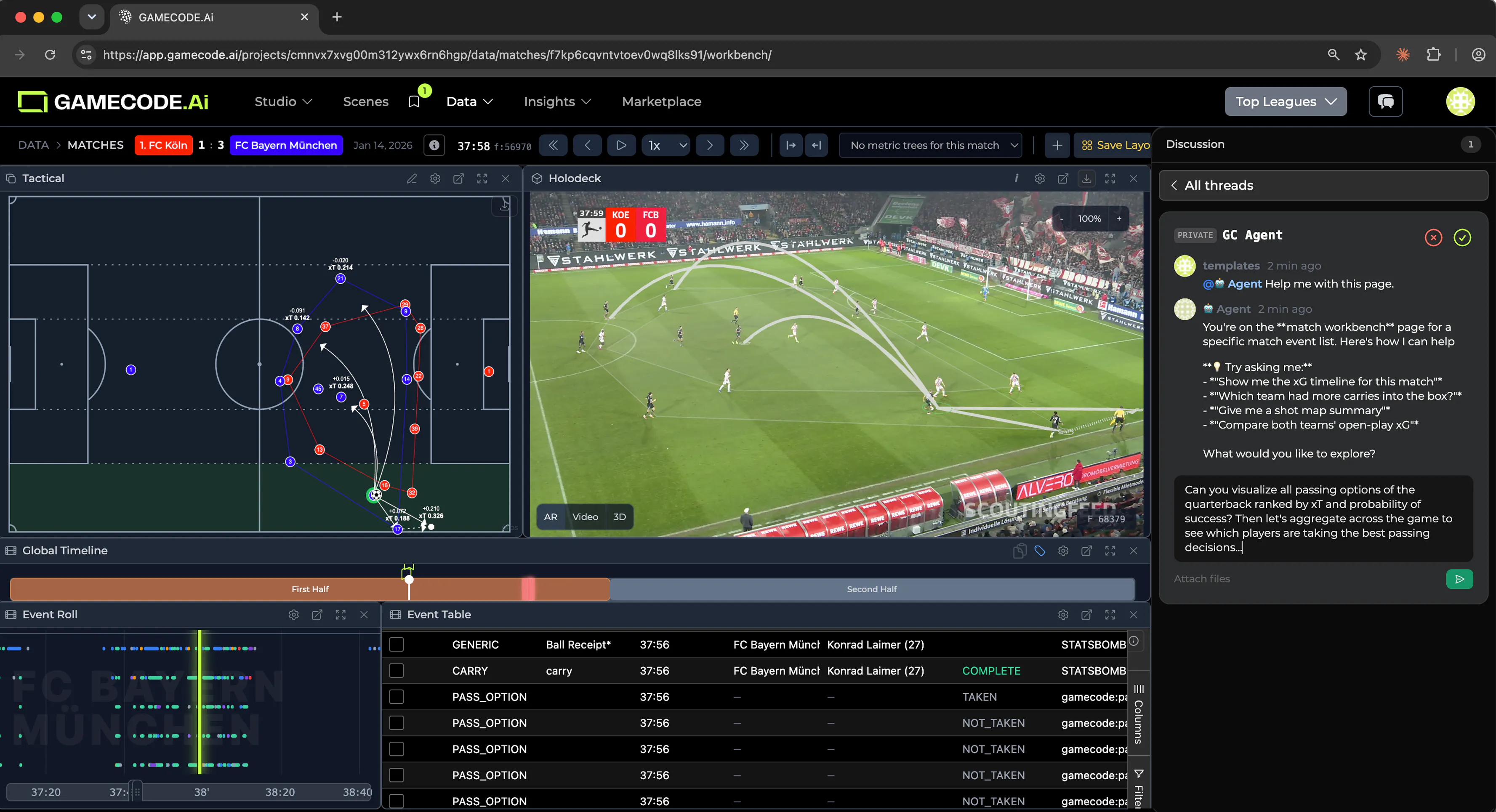
It captures the 99% others miss. Through hardware-agnostic tracking – pose estimation, gaze, and off-the-ball positioning across both matches and training – GAMECODE.Ai measures the decision-making and movement that generic event data can't reach. The very things that decide whether a player suits your system become measurable.

02

Your game model becomes the product. With a "Lego-style" custom KPI builder, you define your football philosophy in plain language and turn it into your own bespoke metrics. Every target is then assessed through your lens, not a generic benchmark.

03

You own the IP. The models you build are yours – a proprietary recruitment asset that lives inside your club, not a methodology you rent and share with your rivals. Your data, your models, your edge.

04

It works with what you already have. Onboarding is straightforward: start with your existing data immediately, then add GAMECODE.Ai's tracking where you want deeper truth. You don't rip anything out to begin.

Core insights

Key takeaways to remember

01

Standardised football data gives every club more or less the same shortlist. The real edge comes from measuring players against your own system.

02

Football analytics captures under 1% of the game; the off-ball decision-making that decides recruitment fit is still mostly unmeasured.

03

Recruitment is really about two things generic metrics can't answer: philosophy-fit and squad-fit.

04

Codifying your game model into custom KPIs turns your style of play into a scouting filter that surfaces value.

05

Modelling how a target player would perform inside your current squad de-risks the most expensive decision your club makes each year.

Deep Dive

FAQ

How can data improve transfer window decisions?

By moving beyond generic benchmarks to measure the specific behaviours your system needs. Custom, club-specific KPIs help you identify players who fit your philosophy and your squad, surfacing undervalued targets and reducing costly mismatches.

Why do so many clubs end up chasing the same players?

Because most scouts use the same standardised football data. Building your own metrics around your own identity reveals what the wider market doesn't see.

What is philosophy-fit in player recruitment?

It's how well a player performs the specific actions your style of play demands – your pressing triggers, build-up patterns, use of space – rather than how they score on general-purpose stats.

Can analytics measure off-the-ball performance?

Yes. With pose, gaze and tracking data across matches and training, GAMECODE.Ai quantifies positioning, movement and decision-making – the roughly 87.5 minutes per game a player spends off the ball that traditional event data misses.

Does GAMECODE.Ai replace our existing data providers?

No. You can start with the data you already have and layer GAMECODE.Ai on top, adding custom KPI modelling and deeper tracking where you want it. The models you build remain your club's intellectual property.