Data & Analytics

Measuring training sessions:the hours your analytics never see

6 min 09.11.2026

A professional club can tell you, in detail, what happened in every minute of Saturday's match. Ask what happened in Tuesday's session, and the answer is usually a coach's impression, some GPS load figures and a few clips.

That's an odd imbalance when you think about it. The match is ninety minutes the coaching staff can't control. Training is the several hundred hours a season they can. It's where the game model is taught, rehearsed and corrected. Yet in tactical terms it remains the least measured part of the week.

This article looks at why training has been so hard to measure, what a club can learn once it is, and what it takes to capture it.
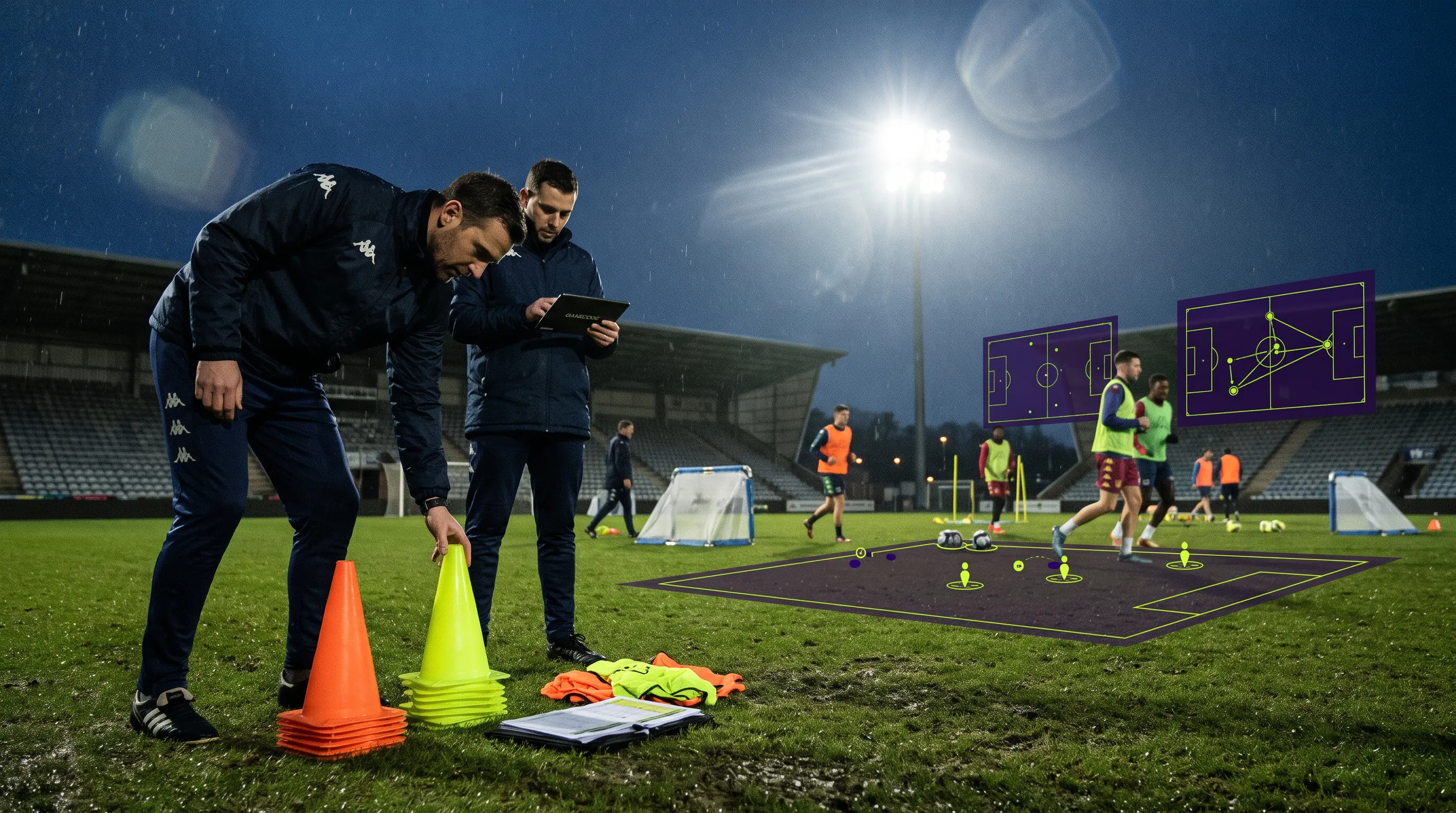
Coaches setting up a floodlit training session with tracking data overlaid on the pitch

Why is training the least measured part of football?

Most of football's data infrastructure was built around matchday. Event data is collected by providers who log every pass and shot in official fixtures. Optical tracking systems are installed in stadiums, and that's where they stay.

Training grounds have a different setup. GPS vests and other physical monitoring tools are widely used, and they do a good job of tracking load, distance and intensity. What they don't capture is the tactical side of a session: where players were in relation to each other, how the shape held, how bodies were oriented when the ball arrived.

So clubs end up with a detailed tactical record of the matches and a mostly physical record of training. The judgement on whether a session worked tactically is still made by eye.

What can you learn from training data?

Once a session produces the same kind of tracking data as a match, a different set of questions opens up.

Did the drill do what it was designed to do? If a session is built to improve compactness between the lines, you can check whether the distances actually shrank, and whether they held as the session went on.

Is the team improving week to week? Training data lets staff compare the same exercise across weeks and see whether the behaviour the coach is asking for is becoming more consistent.

Does training match the demands of the game? You can hold the shape, speed and intensity of a session against what the team faces on matchday, and adjust where they drift apart.

How is each player developing? For academies in particular, session data builds an individual record across seasons. It shows how a young player's positioning, scanning and decision-making change over time, which is very hard to piece together from occasional match footage.

Why does off-the-ball behaviour matter most in training?

Much of what coaches work on in training happens away from the ball. Distances between the lines. The timing of a supporting run. A player checking his shoulder before he receives. Body orientation that lets him play forward first time.

These are the behaviours that make a game model work, and they're the ones event data can't see, because nothing is logged until someone touches the ball. GAMECODE.Ai's own estimate is that around 88.5 minutes per player per match happen off the ball. The ratio in training is unlikely to be better.

That's why positional data alone isn't enough. To measure how a player's body is set up, or whether he looked before he received, you need skeleton and pose data that tracks the position of the body, not just a dot on a pitch map.

What does it take to capture training data?

It used to mean stadium-grade hardware, which is why so few clubs did it. That's no longer the case.

GAMECODE.Ai's Gc:Matrix turns standard cameras into a tracking system. On a training pitch, that typically means cameras in the four corners, with no stadium infrastructure and no proprietary hardware. Where a club already has cameras installed, those can often be used.

From the footage, Matrix produces player and ball positions for every session. The fuller setup adds skeleton and pose data, so body position and orientation are measured too, along with gaze analysis. The data lands in the club's own environment, in a format analysts can open, and sits alongside the match data the club already licenses.

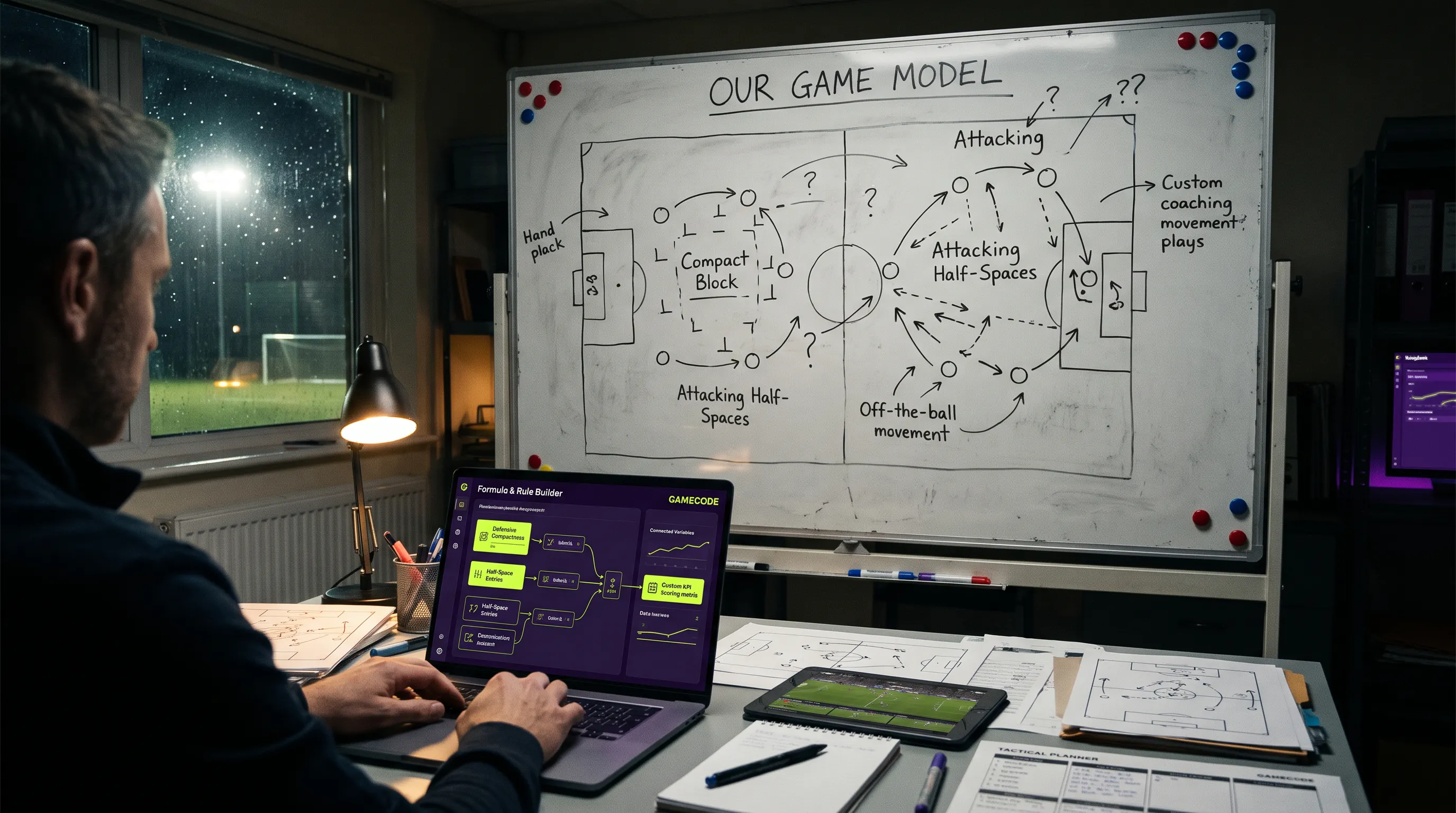
Because the same club-specific KPIs built in Gc:Architect can run on both, a principle of play is measured in the same way on Tuesday as on Saturday. Staff can then ask questions across both through Gc:Pulse, in plain language.

What does this mean for academies?

For academies, training is most of the football a young player plays. Matches are fewer, and the opposition varies a lot from week to week. Training is the consistent environment where development is easiest to see.

Session data that builds up season after season becomes a record of each player's development that the club owns and nobody else holds. It also connects the academy to the first team. If the senior game model is codified into KPIs, the academy can measure young players against the same standard, and see who is closest to stepping up.

Measure the hours you control

Clubs have invested heavily in understanding matches, and that investment has paid off. Training is the next step. It's where the coaching happens, where the game model is built, and where players spend most of their time.

Turning every session into data means coaches can see whether their work is landing, not just hope it is. If you'd like to see what training data looks like on your own pitch, get in touch with the GAMECODE.Ai team.

Core insights

Key takeaways to remember

01

Clubs hold a detailed tactical record of matches but mostly physical data for training, where the game model is actually taught.

02

Training data shows whether a drill produced the behaviour it was designed for, and whether that behaviour improves week to week.

03

The behaviours coaches work on most often happen off the ball, so measuring them needs skeleton and pose data, not just positions.

04

Standard cameras can now capture training as tracking and skeleton data, without stadium hardware.

05

For academies, session data builds a long-term record of each player's development that the club owns.

Deep Dive

FAQ

Can you track training sessions in football without stadium cameras?

Yes. Systems such as Gc:Matrix turn standard cameras, typically placed in the four corners of a training pitch, into a tracking system that produces player and ball positions and, in the fuller setup, skeleton and pose data.

What is the difference between GPS data and tracking data in training?

GPS measures physical output such as distance, speed and load for each player. Camera-based tracking captures where every player and the ball are in relation to each other, which is what you need to measure tactical behaviour.

What can analysts learn from training session data?

Whether a drill produced the intended behaviour, how the team's shape and distances change across weeks, and how training intensity compares with match demands. It also builds individual development profiles over time.

Why is skeleton data useful in training analysis?

Skeleton or pose data shows how a player's body is positioned and oriented, not just where he is. That makes it possible to measure behaviours like scanning and receiving on the half-turn.

How does training data help academy player development?

It gives academies a consistent, season-by-season record of each player's positioning and decision-making. Measured against the first team's KPIs, it also shows which players are closest to the senior game model.